Introduction
Manufacturing is no longer defined solely by machines, assembly lines, and manual supervision. Today’s production environments are becoming increasingly connected, responsive, and data-driven. This shift has given rise to smart manufacturing —a modern approach to production that improves how factories operate, adapt, and perform.
At its core, smart manufacturing focuses on using real-time data, connected systems, and intelligent processes to enhance efficiency, quality, and operational visibility. Instead of relying on reactive decision-making, manufacturers can monitor performance continuously and optimize production in a more proactive way.
Often associated with the smart factory and digital manufacturing, smart manufacturing represents a practical transformation of day-to-day industrial operations.
In this page, we'll explore what smart manufacturing really means in practical terms and why it is becoming a critical part of modern production environments.
Definition of Smart Manufacturing
Smart manufacturing is an advanced production approach that uses connected systems and real-time data to improve how factories operate. It integrates physical manufacturing processes with digital capabilities to enhance efficiency, flexibility, and performance.
From an operational perspective, smart manufacturing creates a connected factory environment where machines, systems, and workflows are aligned. Instead of working in isolated silos, production assets share information that supports faster and more accurate decision-making.
A key aspect of smart manufacturing is data-driven decision making. Production insights are based on live performance metrics rather than manual reporting, allowing teams to optimize output, reduce downtime, and maintain quality standards more effectively.
Real-time visibility across operations enables intelligent production strategies, where issues can be identified early and processes adjusted quickly. By combining digital manufacturing practices with increasingly autonomous systems, manufacturers can build production environments that are more responsive, efficient, and competitive.
Scope of Smart Manufacturing
The scope of smart manufacturing extends beyond individual machines or isolated production lines. It covers the integration of people, processes, and digital systems across the entire manufacturing ecosystem. This includes shop-floor operations, maintenance management, quality control, inventory coordination, and supply chain connectivity.
Smart manufacturing can operate at multiple levels — from a single production cell to multi-plant global operations. Its scope also includes cross-functional data visibility, enterprise-wide performance monitoring, and continuous improvement initiatives driven by connected infrastructure.
In essence, the scope defines how broadly smart manufacturing capabilities can be applied across operational and organizational boundaries.
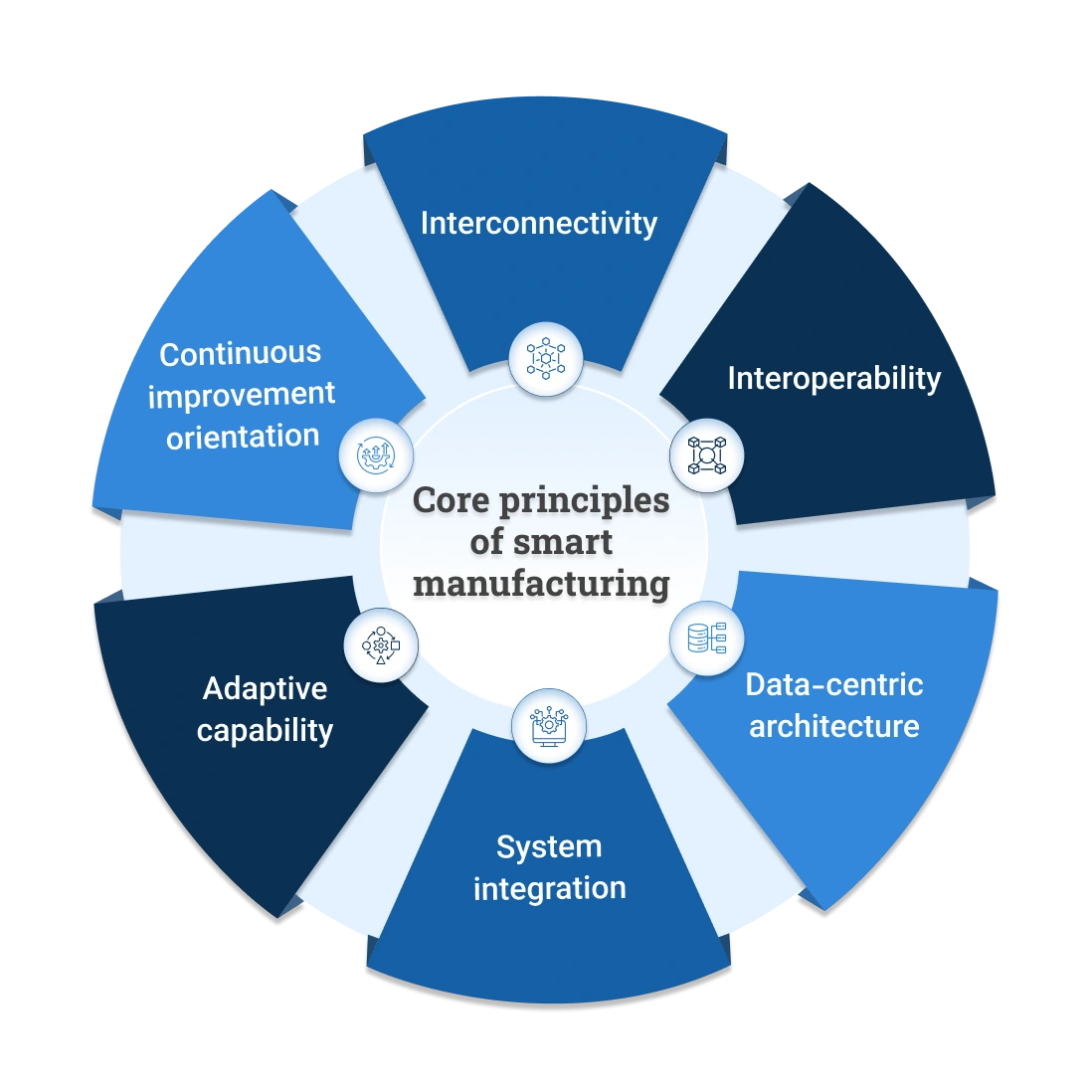
Core Principles of Smart Manufacturing
Smart manufacturing is built on foundational principles that guide how intelligent production systems
are designed and evolved.
-
Interconnectivity – All assets and systems operate within a digitally connected
environment rather than isolated silos.
-
Interoperability – Platforms and technologies are designed to communicate
seamlessly across operational layers.
-
Data-Centric Architecture – Decisions are grounded in structured, accessible,
and continuously generated operational data.
-
System Integration – Production, maintenance, and enterprise systems function
as part of a unified digital framework.
-
Adaptive Capability – Production environments are structured to respond
dynamically to internal and external changes.
-
Continuous Improvement Orientation – Optimization is embedded into the system
design, not treated as a one-time initiative.
Smart manufacturing is built on foundational principles that guide how intelligent production systems are designed and evolved.
- Interconnectivity – All assets and systems operate within a digitally connected environment rather than isolated silos.
- Interoperability – Platforms and technologies are designed to communicate seamlessly across operational layers.
- Data-Centric Architecture – Decisions are grounded in structured, accessible, and continuously generated operational data.
- System Integration – Production, maintenance, and enterprise systems function as part of a unified digital framework.
- Adaptive Capability – Production environments are structured to respond dynamically to internal and external changes.
- Continuous Improvement Orientation – Optimization is embedded into the system design, not treated as a one-time initiative.
How Smart Manufacturing Works
Smart manufacturing operates through a structured workflow where data flows continuously across systems, enabling production processes to be monitored, analyzed, and improved in real time. Rather than functioning as isolated activities, each stage of the manufacturing cycle is digitally connected, forming an integrated and responsive production environment.
Data Collection (IIoT Sensors, Machines)
The process begins on the shop floor. Machines, equipment, and production lines are equipped with industrial IoT (IIoT) sensors that capture data such as temperature, vibration, cycle time, output rates, and quality metrics. This continuous data collection provides accurate, real-time insight into how operations are performing at any given moment.
Data Integration (MES, ERP, Cloud)
Collected data is then transmitted to centralized systems such as Manufacturing Execution Systems (MES), Enterprise Resource Planning (ERP) platforms, or cloud-based infrastructure. Integration ensures that information from different departments—production, maintenance, inventory, and supply chain—is aligned and accessible. This eliminates data silos and creates a unified operational view.
Analytics & AI Processing
Once integrated, the data is analyzed using advanced analytics and AI models. Patterns, anomalies, and performance trends are identified automatically. This stage transforms raw data into actionable insights, helping teams predict equipment failures, optimize scheduling, and improve product quality.
Automated Execution & Optimization
Insights generated from analytics can trigger automated responses. Machines may self-adjust, maintenance alerts can be issued, or production schedules can be recalibrated without manual intervention. This creates a closed-loop manufacturing system where data not only informs decisions but directly influences execution.
In a closed-loop environment, performance is continuously measured, analyzed, and optimized—allowing production systems to adapt dynamically and improve over time.
Core Technologies Behind Smart Manufacturing
Smart manufacturing is powered by a combination of digital and operational technologies that work together to create connected, data-driven production environments. These technologies enable monitoring, analysis, automation, and continuous optimization across the factory floor.

Industrial IoT (IIoT)
Industrial IoT forms the foundation of smart manufacturing. Sensors, devices, and machines are connected through secure networks to collect and transmit operational data in real time. IIoT enables equipment monitoring, condition tracking, and performance measurement, providing the raw data needed for visibility and control.
Artificial Intelligence & Machine Learning
Artificial intelligence (AI) and machine learning (ML) transform production data into predictive and prescriptive insights. These systems detect patterns, forecast equipment failures, optimize production schedules, and improve quality control. Over time, machine learning models refine their accuracy, supporting more precise operational decisions.
Robotics & Automation
Advanced robotics and automated systems enhance speed, consistency, and precision on the shop floor. Collaborative robots (cobots), automated material handling systems, and programmable machinery reduce manual intervention while maintaining high levels of repeatability and efficiency.
Digital Twins
A digital twin is a virtual representation of a physical asset, production line, or entire facility. By simulating real-world operations in a digital environment, manufacturers can test process adjustments, identify bottlenecks, and predict outcomes before making physical changes.
Cloud & Edge Computing
Cloud computing provides scalable infrastructure for data storage, system integration, and remote access. Edge computing complements this by processing critical data closer to the source—directly on devices or local servers—reducing latency and supporting faster decision-making in time-sensitive operations.
Advanced Analytics & Big Data
Smart manufacturing environments generate large volumes of structured and unstructured data. Advanced analytics tools process this data to uncover trends, improve forecasting, and support performance benchmarking. Big data capabilities allow manufacturers to analyze operations across multiple plants or global facilities.
Together, these technologies create the technical backbone of smart manufacturing systems, enabling integrated, efficient, and scalable production operations.
Benefits of Smart Manufacturing
Smart manufacturing delivers measurable operational and financial improvements across production environments. Organizations that adopt connected and data-driven systems typically see improvements in the following areas:
- Reduced Downtime
Predictive maintenance and real-time monitoring can lower unplanned downtime by 30–50%, minimizing production disruptions and maintenance-related losses. - Increased Overall Equipment Effectiveness (OEE)
Continuous performance tracking and process optimization often improve OEE by 10–20%, increasing availability, performance efficiency, and quality output. - Lower Operational Costs
Automation, energy optimization, and improved scheduling can reduce operating costs by 15–25%, particularly in high-volume manufacturing environments. - Faster Time-to-Market
Digital production planning and streamlined workflows enable quicker product iterations and reduced lead times, accelerating go-to-market cycles by up to 20%. - Improved Quality Control
Real-time defect detection and automated inspection systems help reduce quality issues by 20–40%, lowering rework rates and warranty claims. - Data-Driven Decision Making
Access to accurate, real-time production data improves planning accuracy and reduces reliance on manual reporting, leading to faster and more informed operational decisions. - Better Resource Utilization
Optimized material usage, workforce allocation, and machine scheduling can improve resource efficiency by 10–30%, reducing waste and improving productivity.

These outcomes make smart manufacturing not just a technological upgrade, but a strategic investment in operational performance and competitiveness.
Smart Manufacturing vs Traditional Manufacturing
Smart manufacturing transforms production from reactive control to continuous, data-driven optimization. The differences are operational, measurable, and impact day-to-day performance across the factory floor.

In traditional environments, performance insights are often gathered after issues occur. Smart manufacturing environments, by contrast, enable continuous monitoring and faster adjustments—reducing downtime, improving OEE, and increasing overall operational agility.
Smart Manufacturing vs Industry 4.0 vs Industry 5.0
Although these terms are often used interchangeably, they represent different layers of industrial transformation.
- Industry 4.0 focuses on industrial digitization — integrating cyber-physical systems, IoT, automation, and data exchange into manufacturing environments. It defines the technological shift toward connected production.
- Smart Manufacturing represents the practical execution of these digital capabilities within daily production operations. It emphasizes workflow optimization, real-time visibility, predictive maintenance, and measurable performance improvements on the shop floor.
- Industry 5.0 expands beyond digitization toward human-centric innovation, resilience, and sustainable industrial growth.
In simple terms:
- Industry 4.0 introduces the digital foundation.
- Smart manufacturing applies that foundation operationally.
- Industry 5.0 builds on it with broader strategic and societal priorities.
Real-World Examples of Smart Manufacturing
Smart manufacturing is already delivering measurable impact across industries:
- Automotive: Predictive maintenance systems monitor machine health to prevent assembly line stoppages and reduce downtime.
- Pharmaceutical: End-to-end batch traceability ensures compliance, product integrity, and faster recall management when necessary.
- Electronics: Automated inspection systems use machine vision to detect defects with higher accuracy than manual checks.
- Food & Beverage: Real-time quality monitoring tracks temperature, humidity, and processing parameters to maintain consistency and safety standards.
These applications demonstrate how connected systems directly improve operational control and performance.
How to Implement Smart Manufacturing
Implement smart manufacturing step by step to modernize operations without disrupting production:
- Assess Current Infrastructure: Map processes, identify bottlenecks, and evaluate digital maturity.
- Define Goals & KPIs: Set measurable objectives like improving OEE, reducing downtime, or boosting quality.
- Start Small with Pilots: Test technologies and workflows on a limited scale to validate impact.
- Select Scalable Technologies: Choose MES, IoT platforms, and AI tools that integrate seamlessly with existing systems.
- Introduce AI Strategically: Apply AI where it delivers immediate benefits, such as predictive maintenance or process optimization.
- Engage & Train Your Workforce: Prepare teams, build digital champions, and ensure adoption success.
- Scale in Phases: Expand implementations gradually based on pilot results while maintaining operational stability.
- Measure & Optimize Continuously: Track KPIs and dashboards to ensure progress and identify opportunities for improvement.
Note: For a complete step-by-step guide on transforming operations without disruption, check out our full Smart Manufacturing Roadmap with real-world case studies and practical strategies.
Challenges in Smart Manufacturing Adoption
Despite its benefits, implementation can present challenges:
- Legacy Systems: Older equipment may lack connectivity and require retrofitting.
- Data Silos: Disconnected departments can limit integration efforts.
- Cybersecurity Risks: Increased connectivity expands potential attack surfaces.
- Workforce Skill Gaps: Employees may require training in data analytics and digital tools.
- High Initial Investment: Infrastructure upgrades and system integration require upfront capital.
Addressing these barriers early improves adoption outcomes.
Future of Smart Manufacturing
Smart manufacturing continues to evolve with emerging capabilities:
- AI-Driven Autonomy: Systems increasingly make real-time operational adjustments without manual intervention.
- Self-Optimizing Factories: Production lines automatically refine workflows based on performance data.
- Edge AI: On-device intelligence reduces latency and supports faster decision-making at the machine level.
- Hyperautomation: Integrated automation across production, maintenance, and supply chain functions creates seamless operations.
As these technologies mature, manufacturing environments will become more adaptive, efficient, and interconnected—driving the next phase of industrial performance.
Frequently Asked Questions
Smart manufacturing is a modern approach to production where connected systems and real-time data are used to monitor, analyze, and improve manufacturing operations. It enables factories to operate more efficiently by making informed, data-driven decisions rather than relying solely on manual processes.
Smart manufacturing uses technologies such as Industrial IoT (IIoT), artificial intelligence, machine learning, robotics, cloud computing, advanced analytics, and digital twins. These tools work together to create connected and optimized production environments.
Not exactly. Industry 4.0 refers to the broader concept of industrial digitization, while smart manufacturing focuses on the practical implementation of those digital technologies within day-to-day production operations.
It improves efficiency through real-time monitoring, predictive maintenance, automated workflows, and data-driven optimization. These capabilities reduce downtime, increase equipment effectiveness, and streamline production processes.
Examples include predictive maintenance in automotive production lines, automated quality inspection in electronics manufacturing, batch traceability in pharmaceuticals, and real-time quality monitoring in food processing facilities.
Key benefits include:
- Reduced downtime
- Improved overall equipment effectiveness (OEE)
- Lower operational costs
- Faster time-to-market
- Improved quality control
- Better resource utilization.
Yes. While implementation may vary in scale, small and mid-sized manufacturers can adopt phased strategies—starting with data visibility or predictive maintenance—to gradually build a connected and intelligent production environment.
